Knowing the key components of a door system is essential for selecting the right product and ensuring long-term performance. Each part, from the slab to the sill, plays a role in durability, functionality, and aesthetics. Use this guide to familiarize yourself with the basics before your next project.
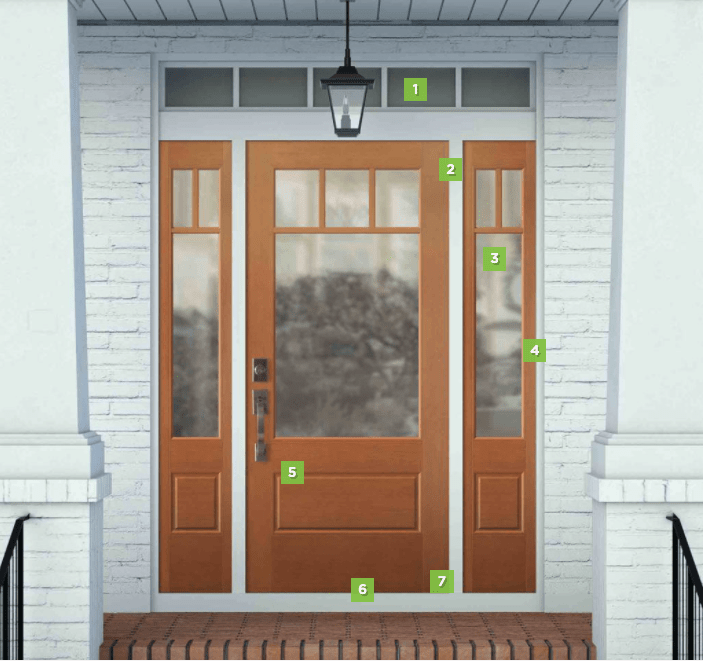
1. Transom
A transom is a window positioned above a door. While often a half-circle, transoms can also be elliptical, rectangular, or even a full circle.
2. Mull Post
The mull post is the structural element between the sidelite (see next definition) and the door. Doors without sidelites do not have mull posts, they only have jambs. Essentially, a mull post is a “double-sided” jamb that helps cover the seal between the door and the sidelite, creating a cleaner, more finished look.
3. Sidelite
A sidelite is a fixed, narrow panel installed next to a door for decorative purposes, typically featuring glass lights. Sidelites are usually positioned adjacent to exterior doors, either within a shared frame or in a separate frame.
4. Brickmold
Brickmold serves as the casing or border around exterior doors, commonly used in pre-hung units. Often referred to as trim or casing, brickmold can be made from various materials, including finger-joint pine, composite, vinyl, or stain-grade wood. Material choice impacts cost and durability, more durable options tend to be more expensive.
5. Door Slab
The door slab is the largest and most recognizable component of a door system. However, its performance depends on the surrounding parts. Even the highest-quality slab will fail if paired with loose hinges, rotting jambs, or a leaky sill.
6. Sill
The sill is the horizontal beam beneath the door that supports the frame and helps keep out the elements. Typically designed with a slope from inside to outside, the sill directs water away from the home or building.
7. Mull Boot
A mull boot is a plastic component that covers the end of the mull post where it meets the sill. It protects against water damage that can lead to rot. While not required, mull boots are a smart investment in wet climates.